













- Magazin online HYDSEALSTORE.RO
- Bucket Bush
- Bushing JDBF
Bushing JDBF


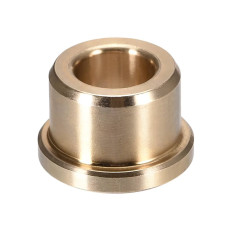

The flanged version of the graphite bronze bushings, JDBF, is designed for joints subjected to both radial and axial loads in hydraulic seals and complex sealing systems.
JDBF bushings retain the self-lubricating advantage of the JDB series but add a flange designed to absorb the axial load without compromising the distribution of graphite inserts across the cylindrical surface. This design makes them ideal for joints simultaneously exposed to significant radial and axial loads, for example, at the mounting points of articulated arms on heavy construction machinery.
The role of the flange in JDBF bushings
The flange at the end of the JDBF bushing absorbs the axial load transmitted by the bolt or rod and limits the lateral movement of the surrounding components. Combined with the solid graphite inserts in the bushing body, it provides both reduced radial friction and axial support in a single component, without the need for a separate component for each function.
The shock resistance of JDBF bushings in heavily loaded joints
In joints exposed to repeated shocks — for example, in construction machinery operating under constant impact — the flange helps to distribute the load over a larger area, reducing the localized pressure that would rapidly damage a bushing without this structure.
Technical criteria for selecting the flanged variant (JDBF)
In addition to the internal and external diameters and length, the flange diameter, its thickness, and how it fits into the housing recess are also important for the JDBF. An incorrect flange fit can lead to axial play even if the other dimensions are correct. For similar applications without a flange, the bushing range offers other compatible variants, and for sealing components on the same machine, bolt scrapers are often used as part of the same repair.
Advantages of buying JDBF bushings from Hydraulic Seals Store
Hydraulic Seals Store lists JDBF bushings with all relevant dimensions clearly displayed, either directly on the shop’s homepage or in the dedicated category. Fast delivery and consistent stock levels minimize waiting times for urgent repairs.
Each JDBF variant in the catalogue has its full dimensions displayed — internal and external diameter, length, and flange diameter and thickness — to ensure you order the correct part the first time. If the equipment has several identical mounting points, ordering the necessary parts at the same time simplifies the planning of a full overhaul of the joints.