













Special Oil Seals



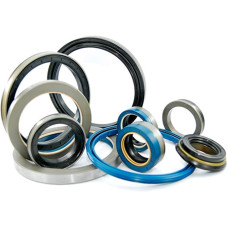

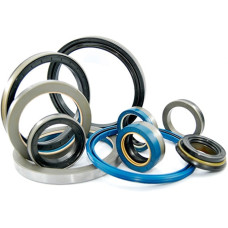
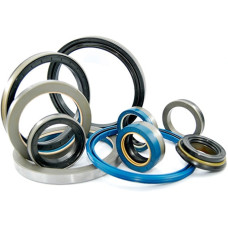
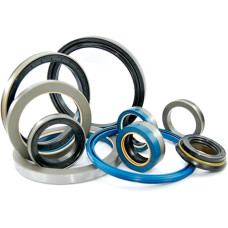
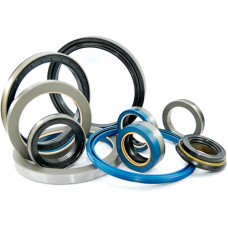
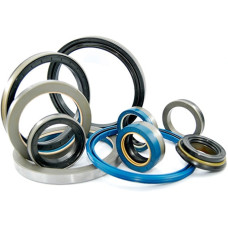
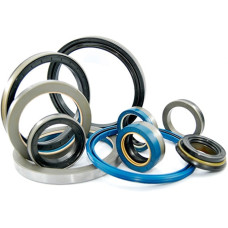
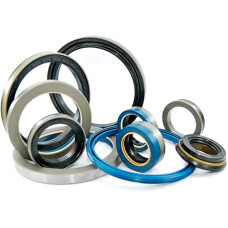
Not all oil seals are built the same, and when your application falls outside the standard parameters — high pressure, high temperatures, or contact with chemicals — you need a specialized variant, not a generic oil seal from the standard range.
Comparison of Viton and NBR materials for special seals
NBR remains the standard material for most applications involving mineral oil at moderate temperatures. Viton (FKM) comes into its own where NBR falls short: it withstands much higher temperatures, contact with fuels, synthetic oils, and numerous aggressive chemicals. The price difference between the two is justified by Viton’s much longer service life under demanding conditions. If the equipment operates under constant pressure, it is worth checking the range of pressure seals as well.
Sealing and lip design in special oil seals
The shape of the sealing lip directly influences the seal’s performance: some models have a double or triple lip, designed to withstand shaft eccentricity or strong vibrations, whilst others have a profile that distributes oil pressure more evenly. For environments with dust or high humidity, the structure is similar to that of COMBI oil seals, but the materials used are adapted to higher stresses.
Selection criteria for special oil seals in abrasive environments
In environments containing abrasive particles — construction sites, quarries, agricultural machinery working with soil or sand — wear on the sealing lip is the main problem. Here, both the hardness of the material and the accuracy of the fit are crucial: a seal fitted crookedly or onto a worn shaft will fail, no matter how good the material is. If installation space is limited, the cassette seal range offers a compact alternative with an integrated housing.
The benefits of buying special oil seals from Hydraulic Seals Store
Hydraulic Seals Store lists special oil seals with the material and dimensions clearly specified in each product listing to help you avoid ordering the wrong item. You can quickly compare the NBR and Viton variants, and the team is on hand to answer technical questions if you’re unsure which one is suitable for your machinery.
Frequently Asked Questions
How does the chemical resistance of Viton differ from that of NBR?
Viton is much more resistant to fuels, synthetic oils, and high temperatures, whilst NBR is suitable for mineral oil and applications at moderate temperatures.
What is the maximum pressure that the sealing lip can withstand?
It depends on the model and material; special double- or triple-lip seals can withstand higher pressures than a standard seal, but the exact value is specified for each product.
How does the special design prevent leaks caused by shaft runout?
The flexible lip, often double, adapts to minor shaft deviations during rotation, maintaining constant contact and preventing leaks in the event of slight eccentricity.
What conditions must be met when fitting oil seals?
The shaft must be clean and free from scratches, and the seal must be fitted straight, without forcing it, using suitable tools to avoid damaging the sealing lip during installation.