













Hydraulic Cylinder Components: The Role of the Piston, Rod and Seals
- Hydraulic Seals Store Editorial Team
- October 10, 2026
- 52
- 0
- 0
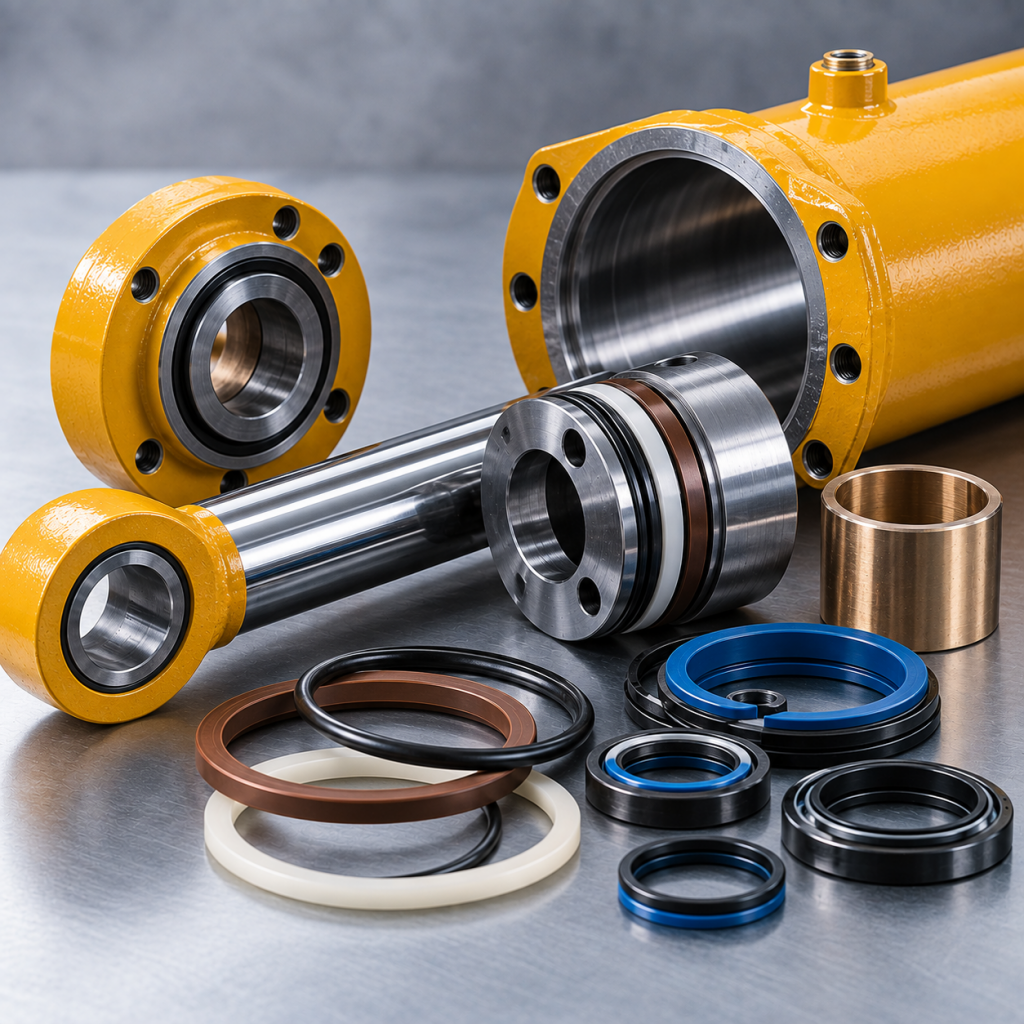
A hydraulic cylinder transforms the pressure of a fluid into linear mechanical force. It is one of the most widely used actuators in modern industry — from excavators and presses to lifting platforms and agricultural machinery — precisely because it is simple, robust and generates enormous forces in a small volume. But its correct operation depends on the condition of each internal component. A single worn or incorrectly installed part can compromise the entire assembly. Knowing the function of each component is basic information for anyone diagnosing cylinder problems or identifying hydraulic components that need to be replaced.
What is a hydraulic cylinder and how does it work
The principle is simple: the hydraulic pump sends pressurized fluid through one of the cylinder connections, the fluid pushes the piston, the piston transmits the force through the rod to the external element that needs to be actuated — a bucket, an arm, a pressing plate. Reversing the direction of flow through the directional valve reverses the direction of the rod — this is a double-acting cylinder, the most commonly used type. In a single-acting cylinder, the fluid acts only in one direction, and the return is achieved by gravity or a spring. The generated force depends on the fluid pressure and the piston area: F = P × A. A pressure of 200 bar on a piston with a diameter of 100 mm generates almost 157 kN — about 16 tonnes of force.
Main components of a hydraulic cylinder
A complete hydraulic cylinder includes: the cylinder body (tube) — the main structure made of steel or aluminum that withstands internal pressure and contains all the other components; the piston with its seals — transforms fluid pressure into mechanical force; the hydraulic rod — transmits the force to the actuated element and exits the cylinder with each extension stroke; the cylinder head (at the open end) — contains the rod sealing system and its guide; the cylinder bottom — with the fluid supply port; mounting joints at both ends; the complete sealing system: piston seals for the cylinder piston, rod seals and wipers and guide rings. Seals, wipers and guide rings are the parts subject to the most frequent wear — they are replaced during every complete cylinder repair.
The role of the piston in cylinder operation
The piston slides precisely inside the cylinder body, with a clearance calculated for smooth movement without excessive leakage. On the circumference of the piston there are one or two grooves with piston seals — the parts that seal the space between the piston and the body and separate the two chambers of the double-acting cylinder. If the piston seals fail, the fluid passes from one side to the other without generating useful force — the cylinder loses power and can no longer hold its position under load without continuous control. The piston itself is rarely replaced, but its seals are wear parts that are changed during every complete repair.
The function of the hydraulic rod and the importance of its strength
The rod is the most exposed component of the cylinder — the only one that extends outside with every extension stroke and comes into direct contact with the working environment: dust, mud, water, temperature variations. It simultaneously withstands compression, tension and lateral bending loads. That is why rods are made of hard chrome-plated or nitrided alloy steel — high mechanical strength plus a smooth and hard surface are essential for the correct operation of the rod seal. A surface that is too rough quickly wears the seal. A scratched or corroded rod wears out the new seals installed after repair within a few hundred cycles. Do not reuse a scratched rod without surface grinding or hard chrome coating — the cost of reconditioning is much lower than the cost of another repair.
The role of seals and sealing systems
The sealing system of a hydraulic cylinder is the most heavily loaded assembly and the one that determines to the greatest extent the service life and reliability of the cylinder between overhauls. Piston seals provide sealing between the two chambers of the double-acting cylinder, preventing internal leaks that reduce force and speed. Rod seals seal the area where the rod exits the cylinder head, preventing visible external oil leaks. Rod wipers clean the rod with each retraction and block external contaminants that would quickly destroy the inner seal. Guide rings guide the linear movement of the piston and rod, preventing direct metal-to-metal contact and absorbing lateral bending loads. O-rings and static seals seal the flanges and fixed joints of the assembly.
The importance of choosing the correct components
A cylinder operates at optimal parameters only if all components are correctly sized and made of materials suitable for the application. Seals made of a material incompatible with the hydraulic fluid — for example, polyurethane with an aggressive HFDU fluid — degrade quickly and cause leaks after a few dozen hours. Guide rings with incorrect clearance generate unwanted lateral movements, noise and localized wear of metal surfaces. Lower-quality parts with wide tolerances result in much shorter repair intervals and higher total costs. A range of seals for hydraulic cylinders with certified materials and correct dimensions significantly reduces the frequency of interventions.
Frequently Asked Questions
What components does a hydraulic cylinder have and what is the role of each part?
The cylinder body, the piston with seals, the hydraulic rod, the head with the rod sealing system, the bottom with the supply port and the joints. Piston seals, rod seals and wipers are the wear parts that are replaced during every repair.
How does a hydraulic cylinder work and how does it transform fluid pressure into mechanical movement?
Pressurized fluid enters a chamber and pushes the piston, which transmits the force through the rod to the actuated element. The force depends on the fluid pressure and the piston area. Reversing the direction of the fluid reverses the movement of the rod.
What role do hydraulic cylinder seals play in the operation and sealing of the system?
Piston seals prevent internal leaks between the chambers. Rod seals prevent external oil leaks. Wipers protect the seals from external contaminants. Guide rings prevent metal-to-metal contact and ensure precise linear movement.