













Hydraulic Cylinder Repairs: Causes, Steps and Choosing the Right Components
- Hydraulic Seals Store Editorial Team
- October 10, 2026
- 59
- 0
- 0
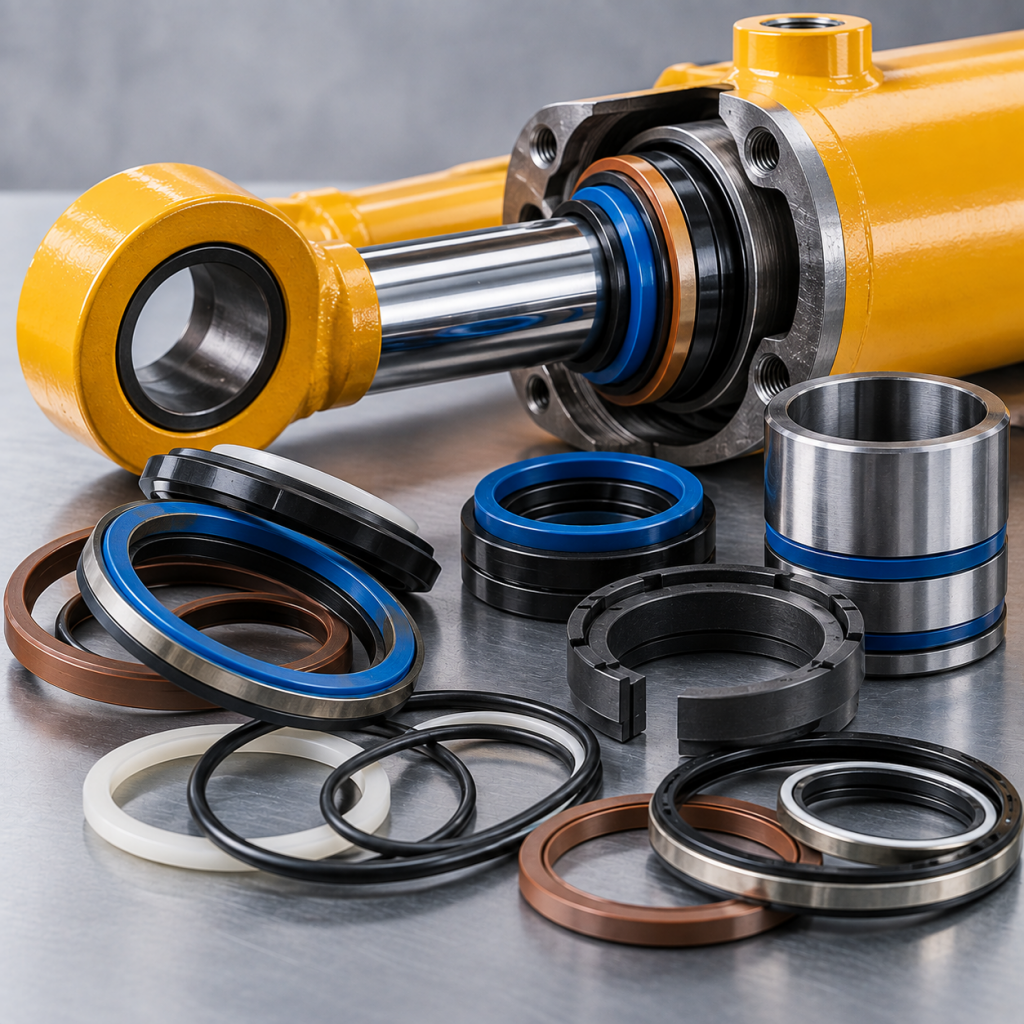
Repairing a hydraulic cylinder is simpler than it seems, but it must be done correctly. Diagnostic or reassembly mistakes are costly — usually through another intervention after a few hundred cycles, or through the failure of a component much more expensive than a set of seals. If you know why cylinders fail, recognize the signs in time and follow the correct steps, you can extend the service life of cylinders and significantly reduce maintenance costs. The key is to understand which components are involved — from sealing elements to guide rings and wipers.
Why problems occur in hydraulic cylinders
Hydraulic fluid contamination is the number one cause. Abrasive particles in the oil — metal, sand, oxides — act as a fine abrasive between the rod and the seal lip, wearing both surfaces faster than anything else. A filter not changed on time, a breach in the sealing system that allows water or dust to enter, or filling with an unsuitable fluid are the main ways contamination enters the system. Changing the filter at the intervals recommended by the equipment manufacturer is the simplest and most effective preventive measure. Normal wear is the second cause: hydraulic seals have a limited service life, determined by the number of cycles, working pressure and fluid temperature. Preventive replacement at the recommended intervals costs much less than an emergency repair. Overloads and operating errors are the third cause: peak pressures that frequently exceed the cylinder limits, direct mechanical impacts on the rod and operation with degraded fluid quickly damage all the seals in the system.
Signs that a hydraulic cylinder requires repair
External oil leaks in the rod or flange area are the clearest sign — a thin film of oil on the rod at rest or a visible active leak means that the rod seal or static seals have worn out. Lower lifting or pushing force than normal indicates internal leakage through the piston seal — the fluid passes from one side to the other without generating useful force, and the cylinder can no longer hold its position under load without slowly retracting. Unstable or jerky rod movement at low speeds or when changing direction suggests wear of the guide seals. Abnormal noises — whining, popping — localized at the cylinder indicate either air in the system through a defective seal or cavitation due to excessive internal leakage. At the first sign, prompt intervention prevents damage to other more expensive components.
Main stages of repair
Correct disassembly is the first step and the most important for the quality of the repair: photograph the assembly before taking anything apart, mark the relative position of the components and completely clean the exterior of the cylinder before opening it. Detailed inspection of each disassembled part — the rod for scratches, corrosion or deformation; the cylinder body for bore wear, ovality; the cylinder head for wear of the seal grooves. Complete cleaning of all metal parts with suitable solvents and complete drying before reassembly are mandatory. Replacement of all seals and worn parts with parts of proven quality — such as replacement hydraulic seals — followed by reassembly with the correct tightening torques and complete functional testing before reinstallation on the equipment.
What parts are replaced during repair
During a complete repair, all wear parts are systematically replaced, regardless of their visual condition. A seal that looks good visually may already be chemically or structurally degraded and will fail shortly afterward, requiring another intervention. Rod seals — rod seals — are the most frequently worn — in permanent contact with the moving rod and the external environment. Piston seals — piston seals — are systematically replaced — their wear causes internal leaks and loss of useful force. Rod wipers, guide rings and all O-rings and static seals at the flanges are completely replaced. The rod is replaced if it has deep scratches or corrosion that exceed the permissible tolerances — a scratched rod quickly wears the new seal and cancels out the investment in the repair.
Recommendations for extending the service life of the cylinder
Planned preventive maintenance is the only practice that keeps cylinders operating at optimal parameters over the long term and reduces total operating costs. Change the hydraulic filter at the recommended intervals — or more often when working in conditions with heavy dust. Visually inspect the rod wiper periodically and replace it at the first signs of wear — cracks, deformation, loss of contact with the rod. Avoid direct mechanical impacts on the rod and operation at pressures that frequently exceed the maximum limits. Store equipment with the rod retracted or protected with a cover during long periods of inactivity. The cost of a complete set of seals for preventive maintenance is usually ten to twenty times lower than the cost of a reactive repair or the equipment being out of operation for several days — a simple calculation that always justifies choosing quality replacement parts for hydraulic cylinders.
Frequently Asked Questions
What does hydraulic cylinder repair involve and when are these interventions necessary?
Repair involves disassembly, inspection, replacement of worn seals and damaged parts and reassembly. It is necessary in case of external oil leaks, reduced force, unstable rod movement or abnormal noises in the cylinder area.
What are the main stages of hydraulic cylinder repair and which components are replaced?
Disassembly, inspection, cleaning, replacement of rod seals, piston seals, wipers and guide rings, reassembly and testing. All seals are replaced preventively, regardless of their apparent visual condition.
In what situations are hydraulic cylinder repairs recommended for industrial equipment?
In case of visible external oil leaks, reduced actuation force or speed, jerky rod movement and abnormal noises. Prompt intervention at the first signs prevents damage to more expensive components of the hydraulic system.
When is hydraulic cylinder reconditioning recommended instead of complete replacement?
Reconditioning is suitable when the cylinder body and rod are in good condition and the problem is limited to worn seals. If the rod or bore is damaged beyond the permissible tolerances, specialized reconditioning or complete replacement are the only correct options.