













Hydraulic Oil Seals: Function, Types and Applications
- Hydraulic Seals Store Editorial Team
- October 10, 2026
- 76
- 0
- 0
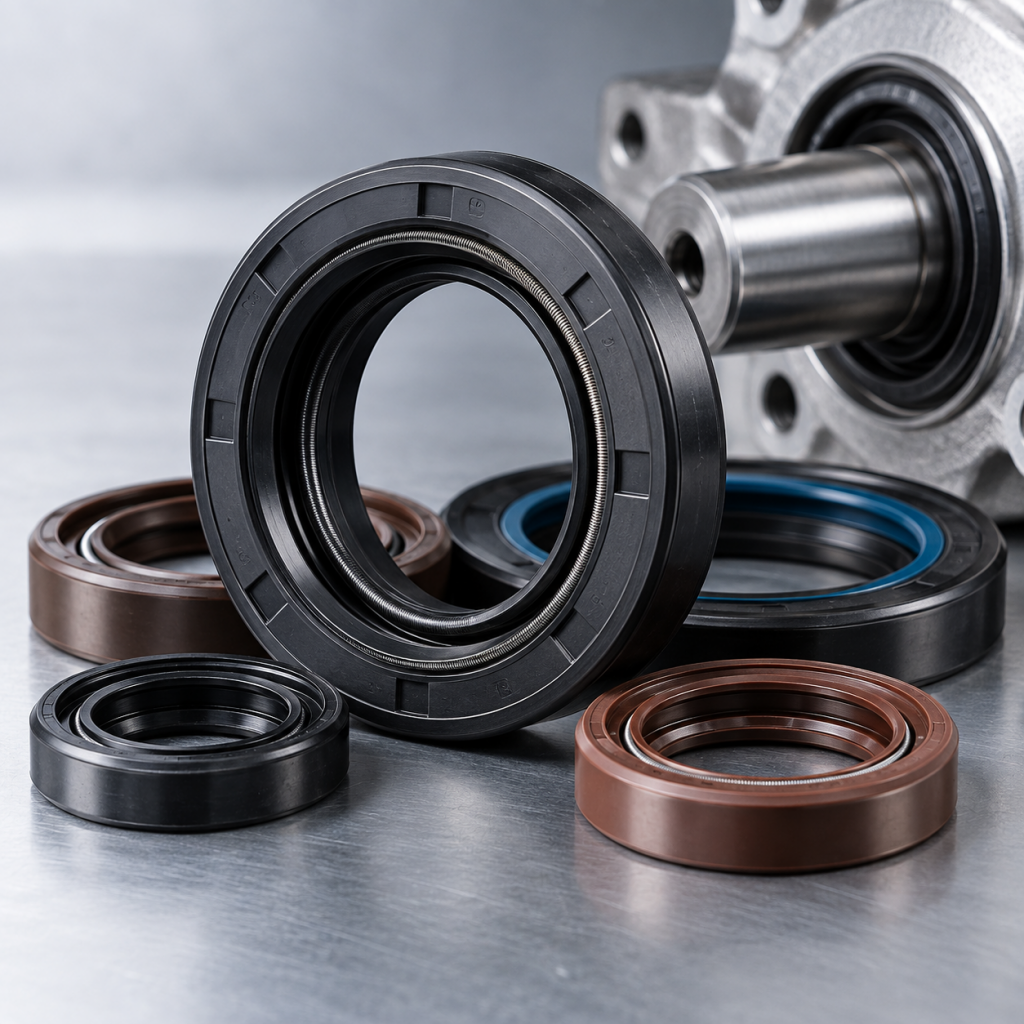
If you have ever worked on a hydraulic pump or a motor with a rotating shaft and have seen oil stains around the shaft, you already know what an oil seal does when it fails. It is the seal that seals the place where the shaft exits the housing — and if it does not work, all the fluid inside is free to leak out. Hydraulic oil seals are present in almost any equipment that combines a rotating shaft with a pressurized fluid, from tractors and excavators to industrial presses and gearboxes. Knowing about them is not an optional technical detail for someone who performs hydraulic maintenance — especially when it comes to choosing the right type of hydraulic oil seals.
What are hydraulic oil seals and what is their role in hydraulic systems
A hydraulic oil seal is a rotary sealing element — it seals surfaces in relative motion, not stationary surfaces. It is installed where the shaft exits the housing and does two things simultaneously: keeps the oil inside and blocks dust, water and particles from the outside. Without it, hydraulic fluid leaks out, contaminants enter and the shaft bearings deteriorate quickly. Compared with static seals, an oil seal works under much harsher conditions: its sealing lip is in permanent contact with a shaft that sometimes rotates at thousands of revolutions per minute. That is why the correct material, profile and dimensions matter enormously. An incorrectly selected oil seal fails quickly and causes leaks or wears the shaft surface — the dimensions and material are just as important as the type. If you are at the selection stage, take a look at the range of hydraulic oil seals.
Operating principle of hydraulic oil seals
The operating principle is simple: the flexible lip of the oil seal is kept in contact with the shaft surface by an internal spiral spring. The spring compensates for the progressive wear of the lip and maintains a constant contact force throughout the product's service life, even after thousands of hours of continuous operation. The rigid outer ring of the oil seal is fixed in the housing seat by interference — it ensures static sealing against the housing and radial fixation. The flexible lip provides dynamic sealing against the shaft. What is interesting: the pressure from inside presses the lip against the shaft, so the higher the pressure, the better the sealing — up to the maximum limit permitted for that type of oil seal. Beyond that limit, the lip can no longer hold and leaks occur.
Types of hydraulic oil seals
The range of hydraulic oil seals is diverse — each type is optimized for specific conditions of pressure, temperature, speed and chemical environment.
Oil seals for hydraulic cylinders
They seal the reciprocating linear movement of the rod, not rotation. The profiles are adapted for repetitive movement in both directions, the pressures specific to industrial and mobile hydraulic cylinders and lower sliding speeds compared with rotary applications.
Oil seals for industrial applications
Designed for hydraulic pumps, hydraulic motors and gearboxes. Designed for continuous operation at high speeds — 1500-3000 rpm — with increased resistance to the temperatures and pressures of heavy and mobile industry.
Special oil seals
Made of FKM, PTFE or silicone, for chemically aggressive environments, extreme temperatures or high pressures that exceed the limits of standard NBR — the variants of special oil seals made of FKM, PTFE and silicone also cover applications where NBR fails. Pressure oil seals have a reinforced construction with a support ring — they prevent material extrusion at pressures exceeding 0.5 bar on the shaft; more about their construction in the section dedicated to pressure oil seals with a support ring.
Materials used for manufacturing oil seals
The lip material determines compatibility with the fluid, the temperature range and service life. NBR is the standard material — compatible with HLP and HVLP mineral oils, operates between -40°C and +120°C, available in most dimensions at affordable prices. FKM (Viton) is chosen when the temperature exceeds +120°C or when the fluid is aggressive: gasoline, HEES synthetic oils, diluted acids. It withstands temperatures up to +200°C. PTFE is used in special chemical applications and where friction must be reduced to a minimum — it does not require lubrication. Silicone operates at extreme temperatures, from -60°C to +230°C, but with lower mechanical resistance compared with NBR or FKM — suitable only at low rotational speeds.
Applications of hydraulic oil seals
Hydraulic oil seals are found in almost every industry that works with rotating shafts and pressurized fluids. The mobile industry uses them in the hydraulic pumps of excavators, bulldozers and cranes, in the drive motors of wheels and transmissions of heavy vehicles, in drive axles and power steering systems. The stationary industry uses them in the hydraulic pumps of industrial presses, lifting systems and automated production lines, in speed reducers and machine tools. The automotive industry uses them in gearboxes, drive axles, power steering systems and brake pumps. The food and pharmaceutical industries use variants made from FDA-certified materials. The right type for each of these applications can be found among oil seals for all areas of use.
Frequently Asked Questions
What are oil seals and where are they used in hydraulic systems?
Hydraulic oil seals are rotary sealing elements that prevent oil leakage where rotating shafts exit pumps, hydraulic motors, gearboxes and transmissions. They are used in mobile and stationary industries, wherever there is a rotating shaft and a pressurized fluid.
How does an oil seal work in hydraulic cylinders?
The oil seal seals the rotating shaft through a flexible lip kept in contact by an internal spiral spring. The hydraulic fluid pressure increases the contact force with the shaft, ensuring dynamic sealing throughout the operation of the equipment.
What are the main types of oil seals used in industry?
The main types are: for hydraulic cylinders (linear movement), for rotary pumps and motors, special oil seals made of FKM or PTFE for aggressive environments and reinforced pressure oil seals for high pressures.
What are the main materials for oil seals?
NBR is the standard material for mineral oils, up to +120°C. FKM for high temperatures and aggressive fluids, up to +200°C. PTFE for special chemical applications. Silicone for extreme temperatures (-60°C to +230°C) at low speeds.