













Types of Hydraulic Bushings and Applications (Materials, Design and Characteristics)
- Hydraulic Seals Store Editorial Team
- October 10, 2026
- 58
- 0
- 0
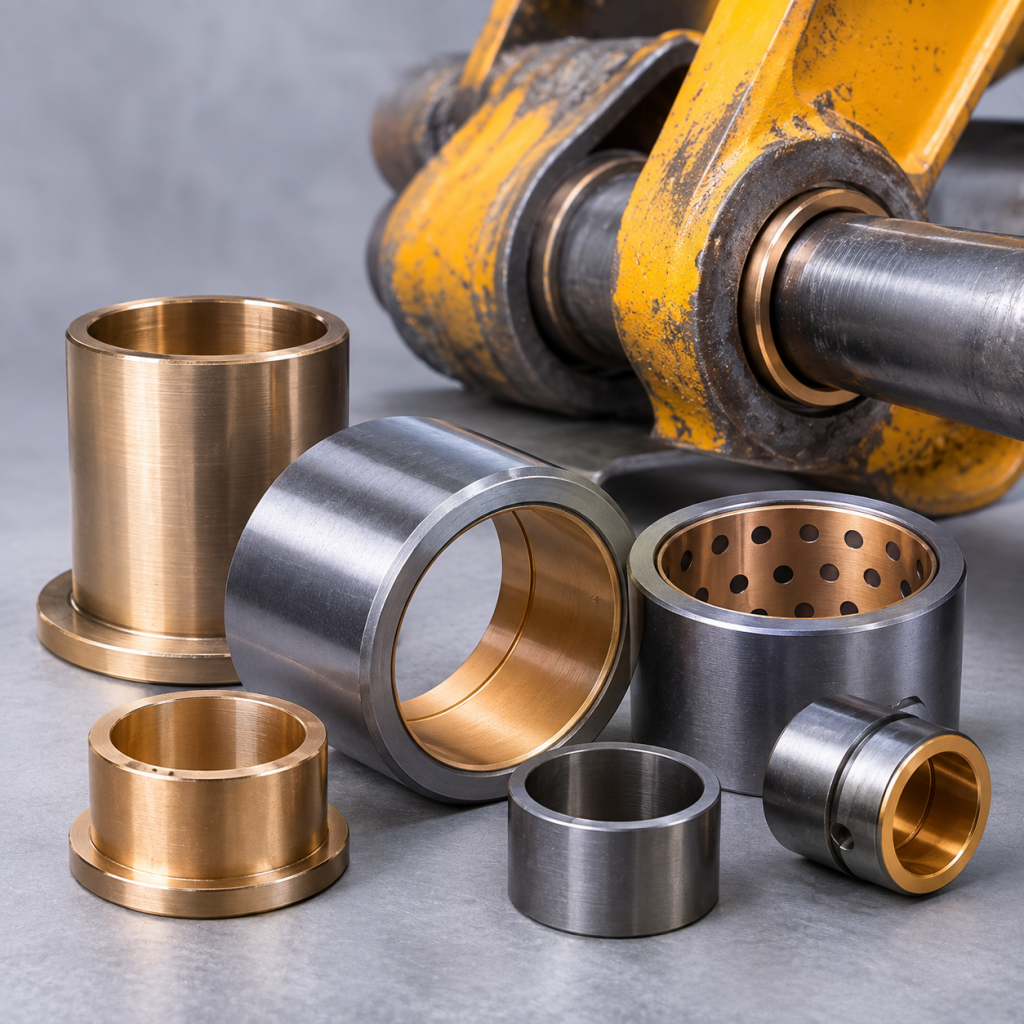
Hydraulic bushings are guiding components and plain bearings without rolling elements, used wherever it is necessary to center a shaft, absorb lateral forces and reduce wear between surfaces in relative motion. They do not seal fluids — that is the job of seals. Bushings guide movement and distribute contact forces, preventing direct metal-to-metal contact that would quickly wear both surfaces. You can find them in the joints of excavator arms and buckets, in steering system pivots, in industrial hydraulic cylinders and in agricultural machinery. The main materials — bronze, bimetallic steel and graphite bronze — cover very different conditions, which makes the correct choice more nuanced than it seems. The differences are explained in detail in the hydraulic bushings section.
What are hydraulic bushings and what role do they play in equipment
A hydraulic bushing is a simple cylindrical part — a body with an inner diameter (= shaft diameter), outer diameter (= mounting bore diameter) and length. The inner surface of the bushing comes into direct contact with the shaft or pivot and absorbs radial loads. Unlike bearings, it has no rolling elements. The bushing material determines the load capacity, wear resistance and whether it requires external lubrication. Some bushings are self-lubricating — PTFE, graphite or porous bronze releases lubricant upon contact with the shaft, eliminating periodic lubrication. Others require external lubrication and are used in systems with centralized lubrication. Manufacturing tolerances matter enormously: too much clearance → poor precision, unwanted shaft movements; too little clearance → excessive friction, overheating, accelerated wear. The technical parameters that define each type are listed in the range of hydraulic bushings section.
Construction and main characteristics of hydraulic bushings
The construction is simple: a cylindrical body with an inner diameter, outer diameter and length specific to the application. The relevant technical parameters are the maximum permissible radial load (kN), maximum sliding speed (m/s), maximum operating temperature (°C), lubrication requirements and corrosion resistance. All of them must be correlated with the actual requirements of the application. A longer bushing distributes the load over a larger surface and reduces wear — if space allows, a greater length is always better. The material is selected according to the radial load, sliding speed, operating temperature, type of lubricant available and working environment (wet, corrosive, dusty).
Types of hydraulic bushings used in industry
The diversity of hydraulic applications requires a varied range of materials and constructions, each suitable for specific conditions.
Bronze bushings
Bronze bushings are the standard solution for high radial loads and moderate sliding speeds. Bronze alloys (CuSn) provide high mechanical strength, while porous or sintered variants are partially self-lubricating — the pores of the material retain lubricant and gradually release it upon contact with the shaft, reducing the need for external lubrication. Suitable for sliding speeds of up to 0.5 m/s without additional lubrication — excavator arms and buckets, steering pivots, industrial hydraulic cylinders. BK-1 bushings are the standard bronze solution for guidance in hydraulic cylinders and industrial mechanisms.
Steel bushings
Bimetallic bushings with a steel body provide superior structural strength compared with solid bronze bushings, making them suitable for high loads and moderate speeds. The typical construction combines an outer steel body, which absorbs the mechanical load, with an inner layer of porous sintered bronze impregnated with PTFE, which provides self-lubricating properties without compromising the strength of the assembly. You can find them in excavator arm and bucket joints, in steering system pivots and in agricultural equipment exposed to variable loads. JDB bushings are bimetallic — a steel body and porous sintered bronze impregnated with PTFE — with excellent self-lubricating properties, without external lubrication.
Graphite bronze bushings
Graphite bronze bushings combine a solid bronze body with graphite inserts distributed over the sliding surface, which act as a permanent solid lubricant. Friction remains low even in applications where external lubrication is difficult to provide or where oil contamination is not acceptable. They are suitable for high loads, low to moderate speeds and dusty or humid working environments, where conventional self-lubricating bushings would quickly exhaust their lubricant reserve.
Applications of hydraulic bushings
Hydraulic bushings are present in practically every category of industrial and mobile equipment that combines the relative movement of two metal components with significant radial loads. Construction machinery uses them in all joints of arms, buckets, steering systems and rotation mechanisms. Agricultural equipment uses them in the joints of lifting mechanisms, steering systems and steering pivots. Industrial hydraulic presses and lifting systems in factories and warehouses use them to center pistons and rods under high lateral loads. Heavy vehicles use them in suspension, steering and transmission systems. Hydraulic cylinders in the same equipment also require hydraulic cylinder seals appropriate for the type of application.
How to choose the right hydraulic bushing
The correct choice is made by correlating the technical parameters with the requirements of the application. The inner diameter must correspond to the shaft diameter with the correctly calculated clearance. The outer diameter must correspond to the mounting bore. Greater length → lower specific pressure → reduced wear. Material: sintered bronze for high loads with speeds up to 0.5 m/s without external lubrication; bimetallic steel (steel body with a layer of sintered bronze impregnated with PTFE) for high loads that exceed the capacity of solid bronze; graphite bronze when external lubrication is difficult to provide or oil contamination is not acceptable. Standard dimensions and available variants are listed in the bushing catalog.
Frequently Asked Questions
What are hydraulic bushings and what is their role in hydraulic systems?
Hydraulic bushings are bearingless guiding parts that center the shaft or pivot, absorb radial loads and protect surfaces from direct metal-to-metal contact. They are used in cylinders, joints, agricultural equipment and construction machinery.
What are the main types of bushings used in industrial applications?
Sintered bronze (high loads, self-lubricating), bimetallic steel with a layer of sintered bronze impregnated with PTFE (high loads, superior structural strength) and graphite bronze, with permanent solid lubrication for environments where external lubrication is difficult.
What should you know about the materials for hydraulic bushings used in their production?
Sintered bronze absorbs high radial loads without external lubrication. Bimetallic steel, with an inner layer of sintered bronze impregnated with PTFE, provides superior structural strength for high loads. Graphite bronze provides permanent solid lubrication, useful where external lubrication is difficult to maintain.
How are the characteristics of hydraulic bushings defined and how do they influence performance?
Maximum radial load, sliding speed, operating temperature and lubrication requirements are the key parameters. Correct sizing prevents premature wear, play in the joint and unplanned equipment downtime.